Generative AI is the technology behind the tools that seem to “make things”: the chatbot that drafts your essay outline, the app that turns a sentence into a painting, the voice that reads your script like a human. The name gives it away. Older AI mostly sorted, predicted or recognised — this email is spam, that photo contains a cat. Generative AI goes one step further: it creates something new that did not exist before, based on patterns it learned from enormous amounts of existing work.
So, what is generative AI, really? Think of it as a very well-read apprentice. It has studied millions of books, pictures, songs and videos — not by understanding them the way you do, but by learning how their pieces fit together. When you give it a prompt, it predicts what pieces should come next to make something that looks and sounds right. That is why its output can feel magical and, at times, slightly wrong in ways a human would never be.
The one idea underneath all of it
Every generative tool, from text chatbots to image makers, runs on the same basic trick: prediction. A text model predicts the next word, over and over, until a paragraph appears. An image model predicts what pixels should look like, step by step, until a picture sharpens out of noise. A music model predicts the next note. None of them is copying a single source. They are remixing patterns learned from many sources, which is why two people with the same prompt still get different results.
This matters because it explains both the strengths and the flaws. Generative AI is wonderful at first drafts, variations and brainstorming, because prediction is fast and fluent. It is unreliable for facts, because it predicts what sounds plausible, not what is true. Keep that distinction in mind and almost every headline about AI makes more sense.
Everyday examples you have probably already used
You do not need a technical background to recognise generative AI. If you have used ChatGPT, Gemini or Claude to draft a message, you have used it. Our comparison of ChatGPT vs Gemini vs Claude shows how the big chatbots differ in practice. If you have typed a sentence into Midjourney or DALL-E and watched an image appear, that is generative AI for pictures — and our guide to Google Gemini covers a free tool that does both text and images.
Other examples are quieter. The “magic eraser” that removes strangers from your photos rebuilds the background generatively. The voice that narrates your video in a language you do not speak was probably generated too. Code assistants that finish your function are predicting the next lines of code, just as a chatbot predicts the next words. Even the background music on some YouTube videos is now generated on demand rather than licensed from a library.
Text, images, video, music: how each one works
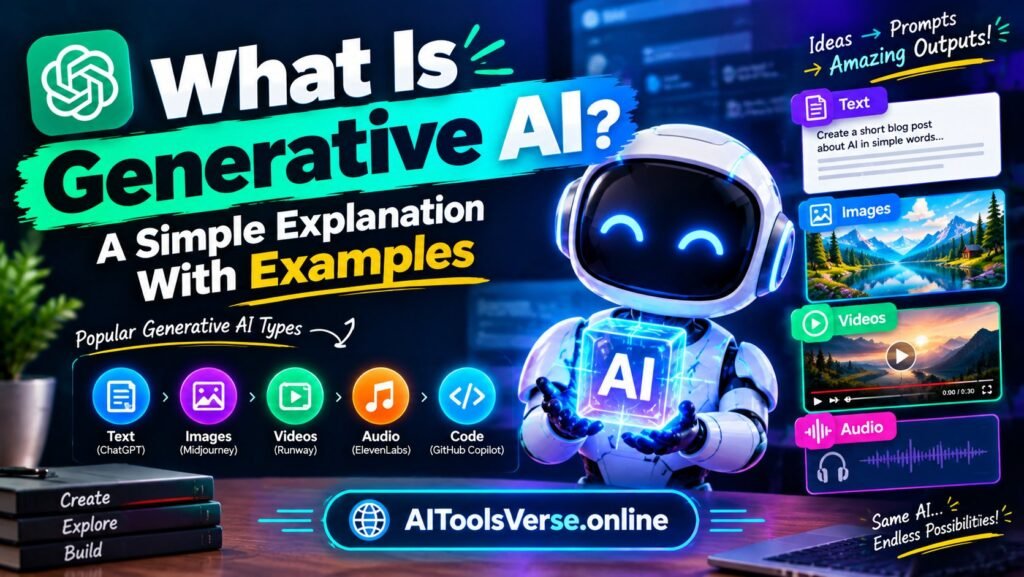
Text generators are the most mature. They are trained on books, websites and documents, and they are best at writing that follows a clear pattern: emails, summaries, scripts, explanations. Image generators work differently — they start from visual noise and gradually refine it toward your description, which is why hands and text in images used to look strange. Video generators extend the same idea across frames, and they are improving fast; our full guide to the best AI video generators compares the leading options. Music generators learn melody, rhythm and style, then compose new pieces in the style you ask for.
Here is a practical way to judge any new tool: ask what it was trained on and what it produces. A tool trained on stock photos will make great marketing images and terrible medical diagrams. A tool trained on pop songs will write catchy choruses and unconvincing classical music. The training data is the ceiling.
What generative AI is genuinely good at
Let us give credit where it is due. For a student, it turns a blank page into a structured outline in seconds. For a small business, it produces product descriptions, social captions and ad variations at a speed no human team of one could match. For a creator, it breaks creative blocks — ten thumbnail ideas, five hooks, three endings — and you pick the best. In our own work, the biggest time saving is not writing from scratch, it is editing: a rough AI draft plus a careful human edit beats either one alone.
It is also a remarkable learning aid when used honestly. Ask it to explain a topic three ways — like you are twelve, like you are a student, like you are an expert — and compare the answers. Ask it to quiz you. Ask it to find the flaw in your argument. Used this way, it behaves less like an answer machine and more like a patient tutor.
Where it falls short, honestly
Generative AI makes things up. It invents citations, quotes and statistics with total confidence. It repeats biases found in its training data. It struggles with recent events unless it can search the web, and even then it can misread sources. It also has no real understanding of your intent — it guesses from your words, and vague prompts get vague results. None of this makes it useless, but all of it means you should treat its output as a draft, not a verdict.
There is also a cost question people skip. Training these models uses enormous computing power, and every prompt you send runs on a server somewhere. That does not mean you should feel guilty for using them, but it does mean the “free” tools are paid for somehow — usually by subscriptions, business plans or, in some cases, your data. Read the privacy policy of any tool you use for sensitive work. OpenAI’s own documentation and IBM’s explainers are good, plain-language places to start learning how the technology works under the hood.

How to use it well, starting today
First, give specific prompts: the audience, the length, the tone, and one example of what “good” looks like. Second, always verify facts that matter — names, dates, prices, medical or legal claims — against a trusted source. Third, keep your voice in the final version: edit the draft until it sounds like you, not like the model. Fourth, do not paste private information into public tools. And fifth, tell people when something is AI-generated if they would reasonably want to know, like a product photo or a testimonial.
Frequently asked questions
Is generative AI the same as ChatGPT? No. ChatGPT is one product built on generative AI. The technology also powers image, video, voice and music tools from many companies.
Will generative AI replace writers and designers? It changes the work more than it removes it. The drafting gets faster; the judgment, taste and fact-checking become more valuable, not less.
Is AI-generated content original? It is newly generated, but it is built from patterns in existing work. That is why you should never present it as your own research, and why editing and attribution still matter.
Generative AI is not magic, and it is not a trick. It is a prediction machine that got so good at predicting that its output became useful. Learn its strengths, respect its limits, and it becomes one of the most practical tools on your computer — as long as you stay the editor in charge.
Next, find out what is a large language model.
For a look at where search itself is heading, read how search is changing in the AI era.