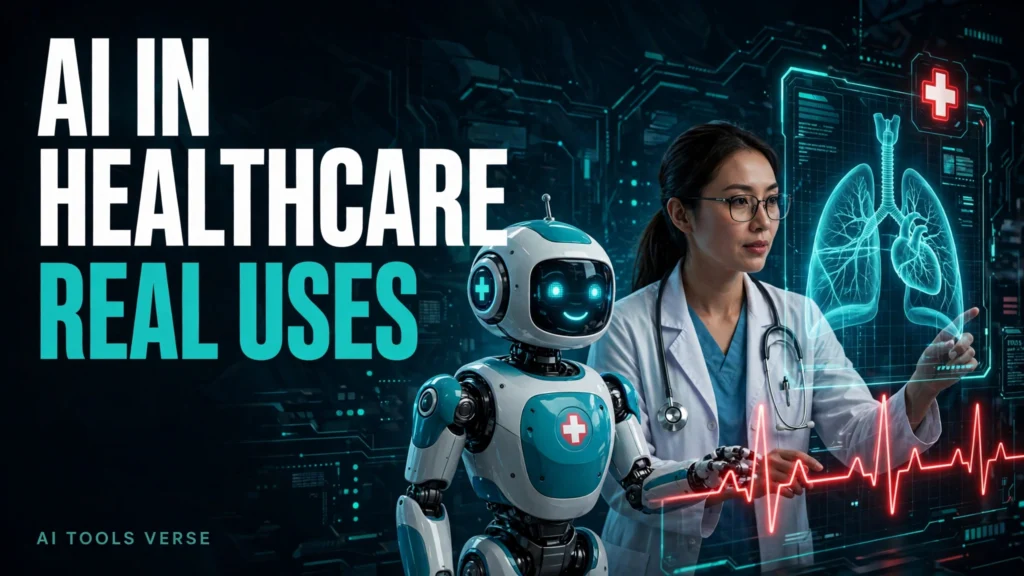
AI in healthcare uses are often described in futuristic terms — robot surgeons, miracle cures, hospitals run by machines. The reality is less dramatic and more useful. AI is already saving time in clinics and hospitals today, mostly in unglamorous places: paperwork, image screening, scheduling, and the first draft of a report. That matters, because time is the scarcest resource in healthcare, and anything that gives clinicians more of it is worth understanding properly.
One caution before we start, and it applies to this whole post: nothing here is medical advice. AI can help clinicians, but it doesn’t replace them, and no chatbot answer should ever substitute for a qualified professional’s judgement about your health.
Table of Contents
Below, we look at AI in healthcare uses that are already saving time in clinics, hospitals and laboratories.
1. Reading medical images, faster
This is the most established use. AI systems trained on thousands of scans can flag possible problems in X-rays, MRIs and retinal images — a suspicious spot, an early sign of disease — and bring them to a radiologist’s attention sooner. The key word is flag, not diagnose. The human expert still makes the call, but AI acts as a tireless second pair of eyes that never gets tired at the end of a long shift.
2. Cutting the paperwork mountain
Ask any clinician what eats their day and paperwork tops the list. AI transcription and summarisation tools can turn a consultation into structured notes, draft referral letters, and summarise a patient’s history before an appointment. Voice AI — the technology behind natural-sounding speech tools — is part of this: a doctor can speak notes naturally and have them organised automatically. Less typing means more time with patients, which is the whole point.
Voice tools are among the most practical AI in healthcare uses for cutting admin time.
3. Spotting patterns humans miss
AI is good at finding subtle patterns across huge datasets: a combination of lab results that suggests a risk, a trend in vital signs that precedes a deterioration, a group of patients who might benefit from early screening. Used carefully, this is early-warning work — not a diagnosis, but a nudge to look closer, sooner. Used carelessly, it risks false alarms and unnecessary worry, which is why these systems need proper clinical testing, not just impressive demos.
4. Speeding up drug discovery
Finding a new medicine used to take years of slow, expensive screening. AI can now predict how molecules might behave, suggest promising candidates, and model protein structures — work that once took laboratories months. It doesn’t replace lab testing or clinical trials, and most AI-suggested candidates still fail, but it narrows the search dramatically. The time saved here is measured in years, not minutes.
These AI in healthcare uses are already shortening research timelines, even though most candidates still fail in trials.
5. Personalising treatment plans
No two patients are identical, and AI helps clinicians tailor care: which treatment worked best for similar patients, what dose is appropriate given a patient’s history, what side effects to watch for. This is decision support, not decision replacement. The clinician weighs the AI’s suggestion against the patient in front of them — their other conditions, their preferences, their circumstances — and that human judgement is irreplaceable.
6. Making healthcare more accessible
For people far from a specialist, AI-powered triage and remote monitoring can be a lifeline: a chatbot that helps decide whether a symptom needs urgent care, a wearable that flags an irregular heartbeat, a tool that describes a skin condition for a remote clinician to review. Multimodal AI, which can look at an image and describe it, is making these tools more capable. None of this replaces a doctor, but for someone with no clinic nearby, a good first assessment is far better than none.
Remote care is one of the fastest-growing AI in healthcare uses, especially where specialists are scarce.
7. Training the next generation of clinicians
Medical students can now practise on AI-simulated patients: take a history, make a diagnosis, explain a treatment, and get feedback without any real patient being put at risk. It’s a safe space to make mistakes and learn from them, and it scales in a way traditional training can’t. The best programmes use AI as a practice partner, with human teachers still guiding the learning.
8. Running the hospital itself
Behind the scenes, AI helps hospitals run: predicting bed demand, scheduling staff, managing stocks of medicines, and routing patients more efficiently. Nobody writes headlines about a well-stocked pharmacy, but a hospital that runs smoothly treats more people, faster, with fewer errors. This operational work may be AI’s biggest quiet contribution to healthcare.
Together, these AI in healthcare uses add up to hours saved across a hospital each week.
The limits, honestly stated
AI in healthcare has real limits, and they matter more here than in most fields because mistakes cost health, not just time. Training data can be biased — a system trained mostly on one population may perform worse for others. AI can hallucinate, inventing a confident-sounding detail that isn’t true, which is dangerous in a medical context. Privacy is critical: health data is among the most sensitive data there is, and tools handling it need the strongest protections. And accountability is unresolved: when an AI-assisted decision goes wrong, the chain of responsibility must be clear, a question our AI ethics guide explores in depth.
What to watch next
The most promising direction isn’t AI replacing clinicians — it’s AI becoming a better assistant to them: summarising faster, flagging earlier, drafting better, and freeing up the human parts of care: listening, explaining, comforting, deciding. Patients should expect to see more AI behind the scenes and, hopefully, more unhurried time with the humans in front of them.
If you’re a student considering medicine, or a patient curious about your own care, the practical takeaway is simple: ask how AI is being used in your care, who checks its outputs, and how your data is protected. Good answers to those three questions are the sign of a system using AI responsibly.

When judging AI in healthcare uses, the same three questions apply: who checks the output, how is data protected, and what happens when it goes wrong?
Frequently asked questions
Can AI diagnose me from my symptoms?
No, not reliably on its own. AI symptom tools can give a rough indication and help you decide how urgently to seek care, but a real diagnosis needs a clinician, examination, and often tests.
Is my health data safe with AI tools?
It depends entirely on the tool. Use only trusted, regulated services for health information, check their privacy policies, and never paste detailed medical records into a public chatbot.
Will AI replace doctors?
The honest answer from most experts is no — it changes what doctors spend time on, shifting routine work to machines and leaving more room for judgement, communication and care. The doctor’s role evolves; it doesn’t disappear.
AI in healthcare isn’t about machines taking over medicine. It’s about giving clinicians back the one thing they never have enough of: time. Used carefully, checked by humans, and protected by strong privacy rules, that’s a genuinely good trade — and it’s already happening, one saved hour at a time.
In short, AI in healthcare uses are most valuable when they give clinicians time back, with human checks in place.
Further reading: the World Health Organization’s guidance on AI in health at https://www.who.int/ and Google DeepMind’s health research at https://deepmind.google/