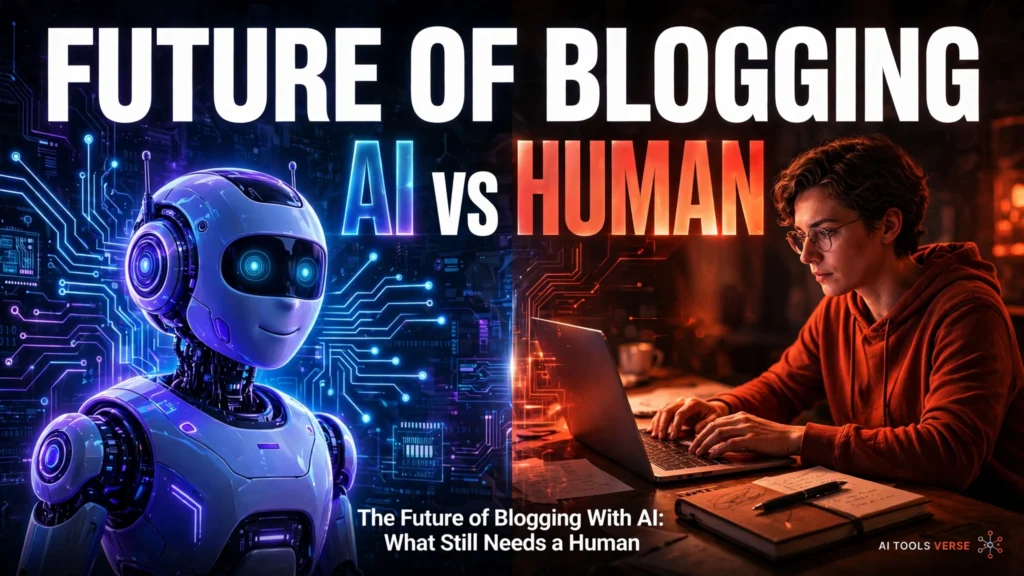
The future of blogging with AI is not about replacing writers. It’s about changing which parts of the job matter most — and the writers who understand that shift are the ones who will keep their readers.
A blogger I follow recently bragged that he published 30 posts in a single day. All AI-written, all posted, all forgotten. His traffic barely moved. Meanwhile another writer I read publishes twice a week, uses AI for the boring parts, and her posts actually get shared. That gap is the whole story of where blogging is heading, and it’s good news if you like writing.
AI has already changed the job. It hasn’t ended it.
What AI already does better than most bloggers
Let’s be honest about where machines win. AI drafts fast. Give it a decent outline and it will hand you 800 words in a minute, including the parts you’d normally put off: the introduction, the transitions, the summary. It’s also a tireless research assistant. Ask it to summarise ten articles and you’ll get the shape of a topic in minutes, not an afternoon.
Repurposing is the other quiet win. One solid post can become a short video script, five social posts and a newsletter section, and AI does the first pass of all of that without complaint. If you’ve ever stared at a finished article wondering how to promote it, you know how valuable that is.
But speed was never the hard part of blogging. The hard part is being worth reading.

The 7 things readers still want from a human
First, taste. AI will happily write about everything and commit to nothing. A human decides what matters, what to leave out, and what angle is actually interesting. That judgement is the article.
Second, real experience. Readers can tell when someone has actually used a tool, made a mistake with it, and learned something. Our guide to generative AI explains the technology, but it’s the hands-on detail — what worked, what didn’t — that makes a post useful rather than just correct.
Third, trust. When a writer puts their name on a recommendation, they are staking something on it. AI stakes nothing. That’s why a post that says “I tried this for two weeks” carries weight that a perfectly smooth AI summary never will.
Fourth, voice. Not fancy writing — recognisable writing. The asides, the opinions, the occasional disagreement with the popular take. AI tends to average every opinion into one polite mush. Readers come back for writers, not averages.
Fifth, accountability. If a claim is wrong, a human can correct it, apologise and explain. An AI-generated page just sits there, confidently wrong, until someone notices.
Sixth, curation. The web does not lack information; it drowns in it. A good blogger is a filter: these three tools are worth your time, the other twelve are not, and here’s why.
Seventh, community. Comments, replies, emails from readers who tried your advice and came back with questions. That loop is a relationship, and no model can have one on your behalf.
A workflow that keeps the human in charge
Here’s the workflow we actually use, and it works. Start with your own outline — your angle, your examples, your verdict. Let AI draft the sections you find tedious, then rewrite anything that sounds like it could belong to anyone. Add at least one thing only you could write: a test result, a screenshot, a mistake you made, a reader’s question you answered.
Then fact-check everything that matters. AI hallucinations are real — our post on why AI makes things up explains how easily a confident-sounding detail can be invented — so every statistic, price and feature claim gets checked against a real source before it goes live. Finally, read the whole thing out loud. If a sentence sounds like it came from a press release, rewrite it until it sounds like you.
That last step takes ten minutes and it is the difference between content and writing.
Here is a concrete example of the future of blogging with AI in practice. Take an old post that still gets search traffic but now lists an outdated price and a discontinued tool. First, open it and note every claim that needs checking, rather than asking AI to rewrite the whole page.
Next, test the current tool yourself, replace the old price with the verified one, and add a short note at the top explaining what changed and why. Then use AI only to draft a tighter introduction and a new summary, rewrite both in your own voice, and read the updated post out loud before you republish it. That step-by-step refresh keeps the future of blogging with AI firmly human-led: the judgement, the testing and the verdict are yours, while AI simply speeds up the routine drafting.
What to do this week if you run a blog
Pick one old post and refresh it by hand: add a current example, fix anything outdated, and put your own verdict at the top. Then write your next post with AI doing no more than a third of the first draft. You’ll feel the difference immediately, and so will your readers. That weekly habit is a simple way to practise the future of blogging with AI without handing over control. And if you’re wondering where chatbots are heading next, the future of ChatGPT in 2026 gives a useful picture of the tools you’ll be working with.
The bloggers who will struggle are not the ones who refuse AI. They’re the ones who hand it the whole job and stop thinking. The ones who will do well are the ones who treat AI like a very fast junior assistant: useful, tireless, and in need of supervision.
Blogging’s future isn’t human versus machine. It’s humans using machines and staying unmistakably human while they do it.
In short, the future of blogging with AI rewards writers who stay visible in their own work, and the future of blogging with AI will keep rewarding that visibility.
Further reading: OpenAI and Google Search Central blog.