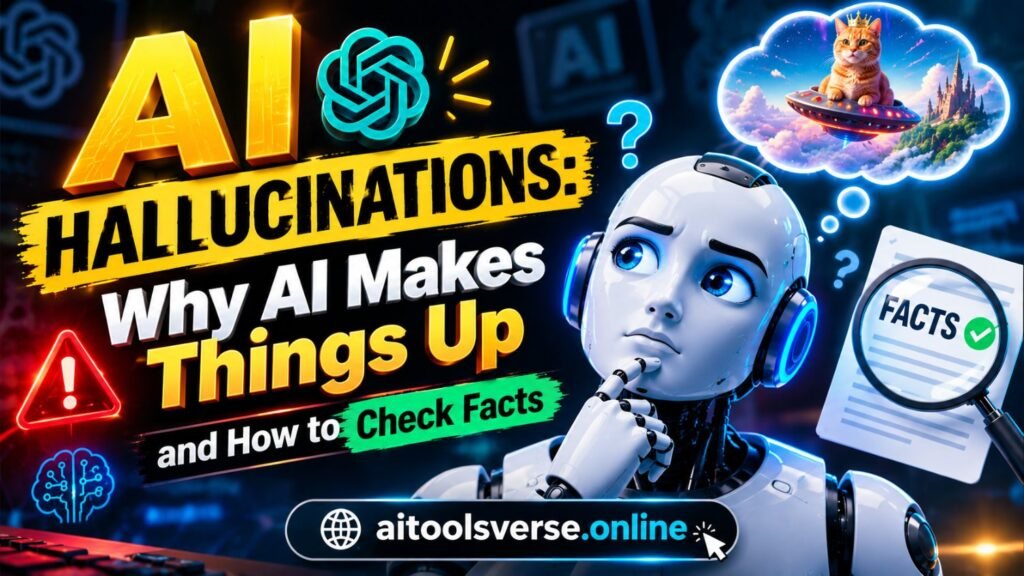
AI hallucinations are one of the most confusing parts of using chatbots today. You’ve probably seen it happen. You ask a chatbot a perfectly normal question, it answers in complete confidence — and then you check, and half of it was made up. A fake quote. A book that doesn’t exist. A date that’s just wrong. It’s unsettling, and it’s the first thing that makes a lot of people distrust AI altogether.
Here’s the thing, though: AI hallucinations aren’t a bug in the usual sense. They’re what happens when a system built to predict plausible language is asked to be factual. Once you understand that difference, the whole problem gets a lot less mysterious — and a lot easier to handle.
What AI hallucinations actually are
An AI hallucination is when a chatbot or AI tool presents invented information as if it were true. It doesn’t warn you. It doesn’t hedge, most of the time. It just states it, smoothly, in the same tone it uses for real facts.
That’s the dangerous part. A search engine gives you links you can check. A chatbot gives you an answer. And because the answer reads so well, your brain is tempted to trust it.
I learned this the hard way while drafting a short piece about a historical event. The chatbot gave me a quote attributed to a famous figure, complete with a year. It sounded right. It wasn’t. The quote didn’t exist anywhere. From that day on, I treat every AI answer the way I’d treat a tip from a confident stranger: interesting, possibly useful, but verified before I repeat it.
Why AI makes things up: 7 reasons
1. It’s predicting words, not checking facts
Large language models work by predicting the next most likely word, based on patterns in enormous amounts of text. They are not looking facts up in a database as they write. So when the most plausible-sounding continuation happens to be wrong, the model will still produce it — confidently.
This is the core of AI hallucinations. Fluency and truth are two different skills, and today’s chatbots are far better at the first than the second.
2. It fills gaps instead of saying “I don’t know”
Humans hate awkward silences. Models, in a way, do too. When a question touches something the model doesn’t know well — an obscure paper, a local event, a very recent development — it often fills the gap with something plausible rather than admitting uncertainty. That gap-filling is where invented citations, fake statistics and imaginary experts come from.
3. Training data has errors in it
AI models learn from the internet, and the internet is full of mistakes, outdated pages and confident nonsense. If a wrong claim appears often enough, or in enough convincing contexts, a model can absorb it as a pattern. Garbage in doesn’t always come out as obvious garbage — sometimes it comes out polished.
4. Vague prompts invite vague answers
Ask a fuzzy question and you’ll often get a fuzzy answer that sounds specific. “Tell me about the study on X” is a classic trap: if no such study exists, some models will happily describe one anyway. The more specific your prompt, the harder it is for the model to drift — but specificity alone doesn’t remove the risk.
5. It tries to please you
Chatbots are tuned to be helpful and agreeable. That tuning can backfire: a model may agree with a false premise in your question, or shape its answer to match what it thinks you want to hear. If you say “I read that X causes Y, can you explain why?”, don’t be surprised if it explains why — even if X doesn’t cause Y at all.
6. Cut-off dates and missing context
A model may simply not know what happened after its training data ends, or it may lack the local context your question needs. Instead of flagging that, it can extrapolate from older patterns. That’s why recent news, new products and fast-moving topics are especially risky territory.
7. Long answers drift
The longer an answer runs, the more chances there are for a small error to snowball. An early invented detail becomes the foundation for the next paragraph, which builds on it again. By the end, the whole chain can feel coherent while being wrong from step two onwards. Short, checkable answers are safer than long, sweeping ones.
Real examples you’ll recognise
- Invented book titles and academic citations that look perfectly formatted but don’t exist.
- Wrong dates, prices and statistics delivered with total certainty.
- Fake quotes attributed to real people — the hardest kind to spot, because the person is real and the quote sounds like something they’d say.
- Confident summaries of events that never happened, or that happened very differently.
None of this means AI is useless. It means AI is a drafting partner, not a source of truth. Treat it that way and it stays useful.
How to check AI facts in under two minutes
You don’t need a research degree. This quick routine catches most AI hallucinations:
- Check the surprising claim first. If one fact would change your decision, verify that one before anything else.
- Search the exact quote or title. Put it in quotation marks in a search engine. If nothing comes up, that’s a red flag.
- Look for a primary source. An official site, a publisher, a university page or a reputable news outlet beats a chatbot’s summary every time.
- Ask for sources, then check them. Tools like Perplexity show their sources — but a listed source still needs a click. A link that doesn’t support the claim is no better than no link.
- Cross-check with a second tool. If two independent sources agree, your confidence goes up. If they disagree, dig deeper before you publish or act.
If you’re writing for publication, there’s one more rule I follow: never quote an AI-generated citation, statistic or quote without finding it somewhere else first. It’s slower. It also saves you from the embarrassment of publishing something that never existed.
What this means for students, creators and small businesses
For students, AI hallucinations are a study risk: a fabricated reference in an assignment can cost marks and credibility. Use AI to explain a concept or brainstorm an outline, then verify the facts from your textbook or course material. Our guide on how students can use AI for exam preparation without cheating covers a safe workflow for exactly this.
For creators, the risk is reputation. One invented fact in a video script or blog post, spotted by a viewer, can undo a lot of trust. Build a fact-check step into your workflow — the same way you’d proofread before publishing. See also what RAG in AI is and why chatbots are getting smarter with your data and AI agents explained: the next big step after chatbots, which both touch on how newer systems try to ground answers in real sources.
For small businesses, the risk is practical: wrong prices, wrong policies or wrong legal-sounding advice in a customer reply can cost real money. Keep AI drafts human-reviewed before they reach customers, especially for anything factual or financial.
The honest bottom line
AI hallucinations won’t disappear overnight, but they’re already getting easier to manage. Retrieval-based systems that check documents before answering, tools that cite sources, and models that are better at saying “I’m not sure” are all moving in the right direction.
Until then, the rule is simple: enjoy the speed, but keep the scepticism. Use AI to think faster, draft quicker and explore ideas — and use your own judgement, plus one quick search, before you trust a fact that matters.
For further reading, see OpenAI’s guidance on accuracy and IBM’s explainer on AI hallucinations.
Frequently asked questions
Do all AI chatbots hallucinate?
Yes, to some degree — it’s a property of how language models work, not a flaw in one particular tool. Some tools hallucinate less, especially when they search the web or check documents first, but none are fact-proof.
Why does AI sound so confident when it’s wrong?
Because confidence in a chatbot’s tone reflects how plausible the wording is, not how verified the fact is. Smooth, fluent text can be completely invented. Tone is not evidence.
Can AI hallucinations be fixed completely?
Probably not with current technology, though they can be reduced a lot — with retrieval systems, source citations, better training and tools that admit uncertainty. For now, verification by the user remains the safety net.
Is it safe to use AI for research?
Yes, if you treat it as a starting point: let it suggest directions, explain concepts and draft outlines, then verify key facts, quotes and citations from primary sources before you rely on them. Clearer prompts also cut down on made-up answers, so see prompt engineering basics for simple tricks that leave less room for guessing.
For a wider look at the ethics behind these mistakes, see our guide to AI ethics for beginners.