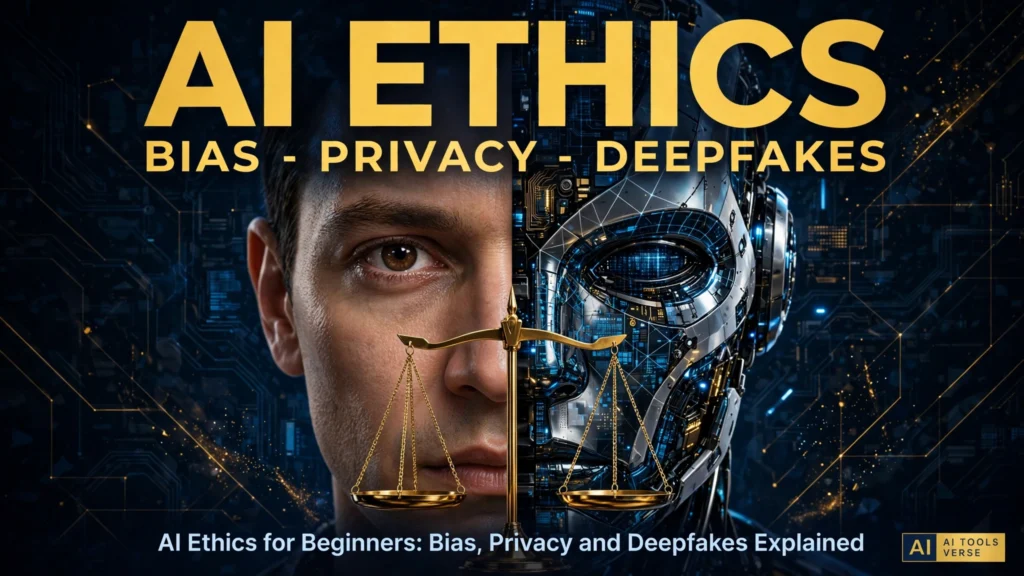
AI ethics for beginners sounds like a university subject, and that’s part of the problem. It sounds abstract, distant, and somebody else’s job. It isn’t. If you’ve ever used a chatbot, uploaded a photo, or trusted an AI recommendation, you’ve already bumped into the ethical questions — you just may not have named them yet.
Here’s a simpler way to think about it. AI ethics is the set of questions we ask when a machine starts making decisions that affect real people. Who benefits? Who gets harmed? Who is responsible when it goes wrong? Those questions matter whether you’re a student, a creator, or just someone trying to use these tools sensibly.
Bias: when AI learns our worst habits
AI learns from data, and data comes from the real world — with all its unfairness included. If a hiring tool is trained on past hiring decisions that favoured one group, it will learn to favour that group. If a photo tool is trained mostly on pictures of one kind of person, it will struggle with everyone else.
This isn’t the AI being prejudiced on purpose. It’s the AI faithfully copying patterns in its training data, including the ones we’d rather not repeat. That’s why bias in AI is so stubborn: the model is doing exactly what it was trained to do, and the training data itself was the problem.
What can you do? Don’t treat an AI output as neutral just because a machine produced it. If an AI tool is screening people, grading work, or making recommendations that affect someone’s chances, ask how it was tested, and on whom. A tool that works well for one group and badly for another isn’t ready to be trusted with decisions about people.
Privacy: what you hand over, and where it goes
Every prompt, photo and voice clip you give an AI tool goes somewhere. With closed tools, it usually goes to a company’s servers, and what happens next depends on that company’s policy — it may be stored, reviewed, or used for further training. Open models you run yourself keep your data local, which is one of the real trade-offs in our open source vs closed AI models comparison.
The practical rule is boring and important: don’t paste anything into a public chatbot that you wouldn’t want a stranger to read. Customer lists, medical details, unpublished work, passwords — keep them out. Check a tool’s privacy settings before you use it for sensitive work, and prefer tools with clear, readable policies over ones that hide behind legal fog. For practical steps on protecting your own data, read our AI tools safety guide.
Deepfakes: when seeing stops being believing
Deepfakes — AI-generated images, audio and video of people doing or saying things they never did — are the most vivid ethics problem most people will meet. A fake video of a politician, a cloned voice asking for money, a realistic photo of an event that never happened: these are no longer science fiction, and they’re getting harder to spot.
The harm isn’t just to famous people. Ordinary people can be targeted too, and once a fake image spreads, correcting it is slow and often incomplete. The defence is partly technical — detection tools, watermarks, platform rules — and partly human: pause before sharing something shocking, check a second source, and remember that a realistic image is no longer proof of anything on its own.
Who is responsible when AI gets it wrong?
This is the question companies would prefer you didn’t ask too loudly. If an AI system denies someone a loan, misdiagnoses a symptom, or invents a false claim about a real person — our post on why AI makes things up shows how easily that last one happens — who answers for it? The user who typed the prompt? The company that built the model? The organisation that deployed it without checking?
There is no settled answer yet, and that’s part of the ethics debate. The direction most experts favour is shared responsibility: builders must test and disclose limits, deployers must check outputs before acting on them, and users must not blindly pass AI claims on as facts. Nobody in that chain gets to say “the AI did it” and walk away.
A practical ethics checklist for everyday users
You don’t need a philosophy degree to use AI more ethically. A short checklist does most of the work. First, check important AI claims against a real source before repeating them. Second, keep private data out of public tools. Third, think before uploading someone else’s photo or voice — consent matters, even for a fun experiment. Fourth, be honest when AI helped you make something, especially if people will rely on it. Fifth, ask who benefits from the tool you’re using, and what it costs the people whose data trained it.
Generative AI is powerful precisely because it was trained on human work — writing, art, code, photographs. That raises a fair question about credit and compensation for the people whose work made these tools possible, and it’s a debate that will run for years. You don’t need to settle it to use AI thoughtfully. You just need to remember there are real people on the other side of every dataset.
Frequently asked questions
Is AI ethics just about robots taking over? No. The real ethics questions are much closer to home: biased decisions, leaked data, fake media, and who is accountable when a system harms someone. The robot-apocalypse version is a distraction from those.
Can AI ever be truly unbiased? Probably not perfectly, because its training data reflects an imperfect world. But it can be tested, corrected and made fairer — and demanding that testing is a reasonable thing to ask of any tool that affects people.
What should I teach my children about AI ethics? Three habits: check before you believe, protect your private information, and think about the person on the other side of the screen before you share or generate something about them.
AI ethics for beginners isn’t about fear. It’s about staying in charge: using powerful tools with your eyes open, protecting the people they affect, and refusing to hand your judgement to a machine just because it’s fast. That habit — pause, check, think about who is affected — is the whole subject, and it’s one anyone can practise starting today.
Further reading: the OECD’s AI principles at https://www.oecd.org/ and the Open Source Initiative’s AI definition at https://opensource.org/