Voice AI explained in one sentence is this: machines learned to talk by listening to enormous amounts of human speech and learning, pattern by pattern, how sound becomes words and words become sound. That sentence hides a revolution, though, because for most of computing history, talking to a machine felt like talking to a wall that occasionally misunderstood you.
If you’ve used a voice assistant in the last year, you’ve probably noticed the change. The voice is smoother. It pauses in more natural places. It handles a follow-up question without you having to repeat the whole context. That’s not one breakthrough — it’s several, stacked on top of each other, and they’re worth understanding because voice is becoming the way many people will use AI first.
Voice AI explained in plain terms is the thread running through this guide: voice AI explained step by step, from listening to speaking, so you can judge both its promise and its limits.
The two halves of voice AI
Voice AI has two jobs, and they’re almost mirror images. Speech recognition turns your voice into text: the system listens to sound waves, breaks them into tiny units, and guesses which words you most likely said. Speech synthesis does the reverse: it turns text into spoken sound, choosing pronunciation, rhythm and emphasis so the result sounds like a person rather than a robot reading a list.
Early versions were bad at both. Recognition stumbled on accents, background noise and names it hadn’t seen. Synthesis sounded flat, because it was stitching together recorded fragments of a human voice. Modern systems do something different: they learn the statistical patterns of speech itself, so they can generate new sentences in a natural-sounding voice they were never explicitly recorded saying.
That last point matters. A modern voice model doesn’t need a recording of every sentence it will ever say. Give it a short sample of a voice — sometimes just seconds — and it can speak new words in that voice. That’s what makes tools like the ones in our ElevenLabs guide so striking, and it’s also what makes voice cloning a genuine safety concern, which we’ll come back to.
Why voices suddenly sound human
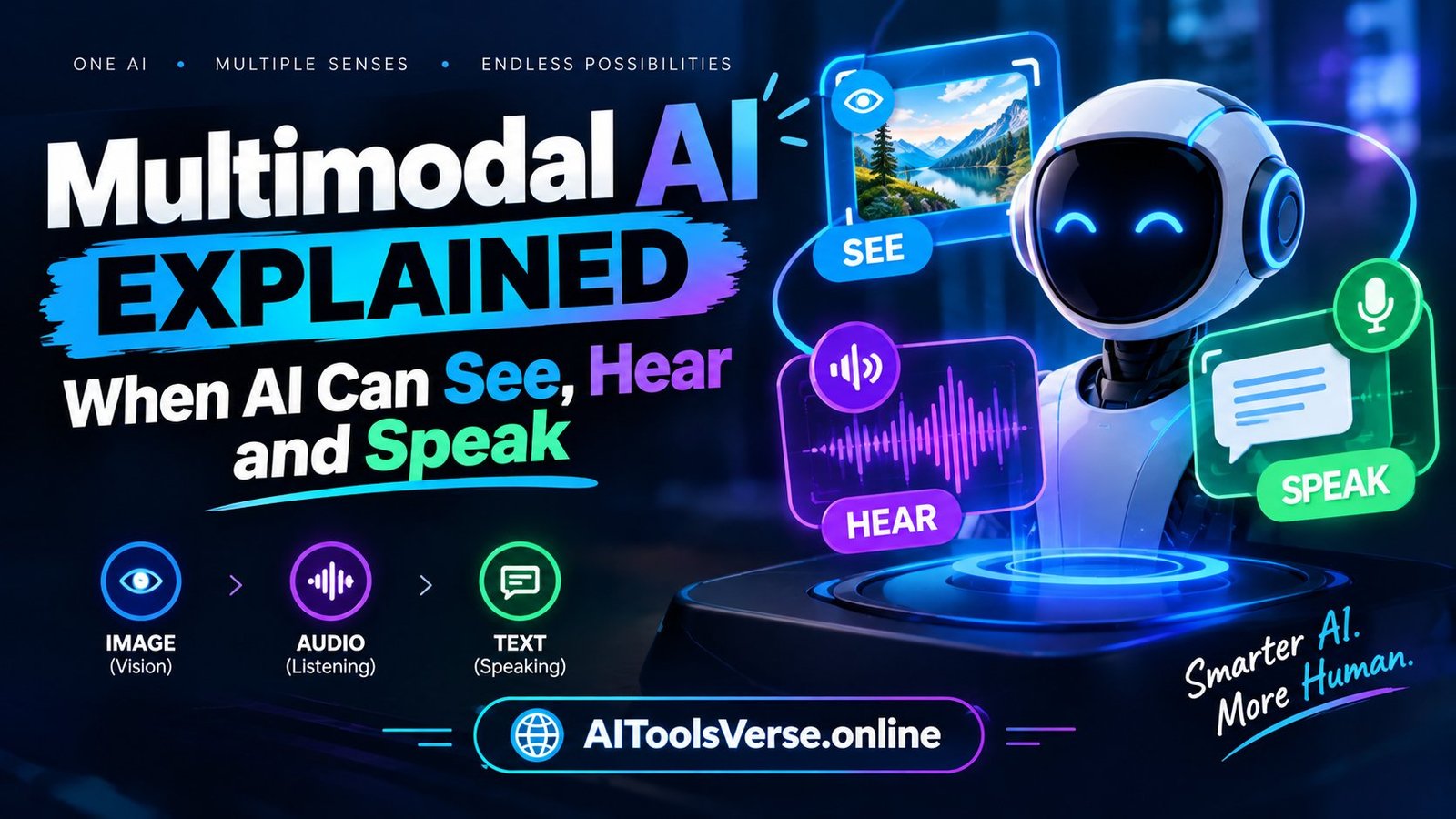
Three things changed at once. First, models got bigger and were trained on far more speech, including conversations, not just clean studio recordings. Second, they started learning context: a good voice model doesn’t just pronounce words, it decides which words to stress, where to pause, and how fast to speak, based on meaning. Third, voice stopped being a separate tool and became part of multimodal AI — systems that handle text, image and audio together, as our multimodal AI explainer describes. A model that understands language deeply can speak it more naturally, because it knows what it’s saying.
The result is uncanny in the best and worst senses. A well-made AI voice can narrate an audiobook, voice a training video, or read a news article aloud in a way that is genuinely pleasant to listen to. It can also imitate a real person closely enough to fool someone on a phone call, and that risk is real, not hypothetical.
Where voice AI actually helps
Accessibility is the clearest win. People who can’t easily read a screen can listen instead; people who can’t type can speak. Language learning gets better too: you can practise conversation with an AI tutor that never gets impatient and corrects your pronunciation on the spot.
For creators, voice AI saves the most tedious hours. Narration, dubbing, and voiceovers that once needed a studio, a microphone and several retakes can now be drafted in minutes, then edited like text — a workflow our Descript guide covers in detail for audio and video. For small businesses, voice assistants can answer common phone questions, take bookings, and handle routine queries without keeping a caller on hold.
For students, there’s a quieter benefit: listening to a difficult text read aloud, at your own speed, can make it click in a way silent reading sometimes doesn’t. Voice AI turns any article into something you can learn from while walking, cooking, or commuting.
The limits you should know
Voice AI still mishears. Accents, dialects, noisy rooms and overlapping speakers all cause errors, and the system rarely admits uncertainty — it just gives you its best guess, confidently. Always check a transcript that matters, especially for names, numbers and medical or legal terms, and remember that fluent-sounding speech can still carry invented facts, the same hallucination problem covered in our post on why AI makes things up.
Latency is another limit. A truly natural conversation needs responses in under a second, and many systems still pause noticeably while they think. And emotion is still faked, in a sense: an AI voice can sound warm or excited, but it doesn’t feel either. That’s fine for narration, but it matters when people start treating a voice assistant as a companion rather than a tool.
Staying safe with voice AI
The safety rules are simple, and worth taking seriously. First, verify unexpected voice messages asking for money or passwords through a separate channel — a cloned voice is now cheap to make. Second, don’t upload voice recordings of other people to cloning tools without their clear permission. Third, treat any voice assistant as a listener: assume what you say may be stored, and check the privacy settings. Fourth, teach children and older relatives that a familiar voice on the phone is no longer proof of identity on its own.
Before the questions below, voice AI explained in one more line: voice AI explained well means remembering that a fluent voice is not the same as a trustworthy source.
Frequently asked questions
How is voice AI different from a normal voice assistant?
Old assistants mostly matched your words to pre-written commands. Modern voice AI understands language, holds a conversation, and generates speech that sounds natural, rather than just playing back recordings.
Can AI really clone my voice from a few seconds of audio?
For many current tools, yes, roughly — a short sample can produce a recognisable imitation. That’s why voice verification alone is no longer a safe way to confirm identity for sensitive requests.
Will human voice actors disappear?
Some routine narration work is already shifting to AI, but performance — acting, emotion, character, comedy — remains very human. The likelier future is a mix: AI for drafts and routine reads, humans for anything that needs real feeling.
Voice AI explained honestly is a story of a tool that finally learned to speak our language — literally. Used well, it makes information accessible, creation faster, and learning easier. Used carelessly, it can deceive and mislead. The difference, as with every AI tool, is whether the human in the loop stays alert, checks what matters, and remembers that a natural-sounding voice is still just a very clever machine.
Further reading: OpenAI’s voice research at https://openai.com/ and Anthropic’s work on AI safety at https://www.anthropic.com/